1
Step 1. Find the yucky motion and score it.
Choose a painful or restricted movement. Give it a score from 0 to 100.
We now have something specific to come back and check.
Both certifications $997. Ends Cyber Monday 11:59 PM Pacific
Both certifications $997. Ends Cyber Monday 11:59 PM Pacific

Get all 7 levels of Total Motion Release for $997. That's both certifications for the price of one, through Cyber Monday.
Picture us in an evaluation.
A patient raises an arm and it feels yucky. That gives us something to retest.
Now I want to find a yummy motion elsewhere in the body, work that motion, and see what changes.
That’s where we start with Total Motion Release.
Choose a painful or restricted movement. Give it a score from 0 to 100.
We now have something specific to come back and check.
Compare simple motions on both sides of the body. Look at the arms, trunk, neck, and legs, wherever the original issue happens to be.
Find the motion that feels yummy.
Do 2 sets of 15 to 20 reps of the yummy motion. Then return to the original yucky motion and reassess.
That retest is where I want your attention.
What changed? The response helps guide what we do next.
Picture a patient coming back with the same yucky motion.
It pulls your attention straight back to the place that hurts.
I want us to pause before we spend the whole visit looking there again.
What have we compared elsewhere? Which motions feel yummy? What happens when we use one of those and retest?
That’s the question behind what I teach as the 12.5% problem and the overlooked 87.5%.
It’s a teaching model for widening the search beyond the painful motion. Useful motions elsewhere deserve a place in the evaluation.
The next step is to give ourselves a clear way to look for them.
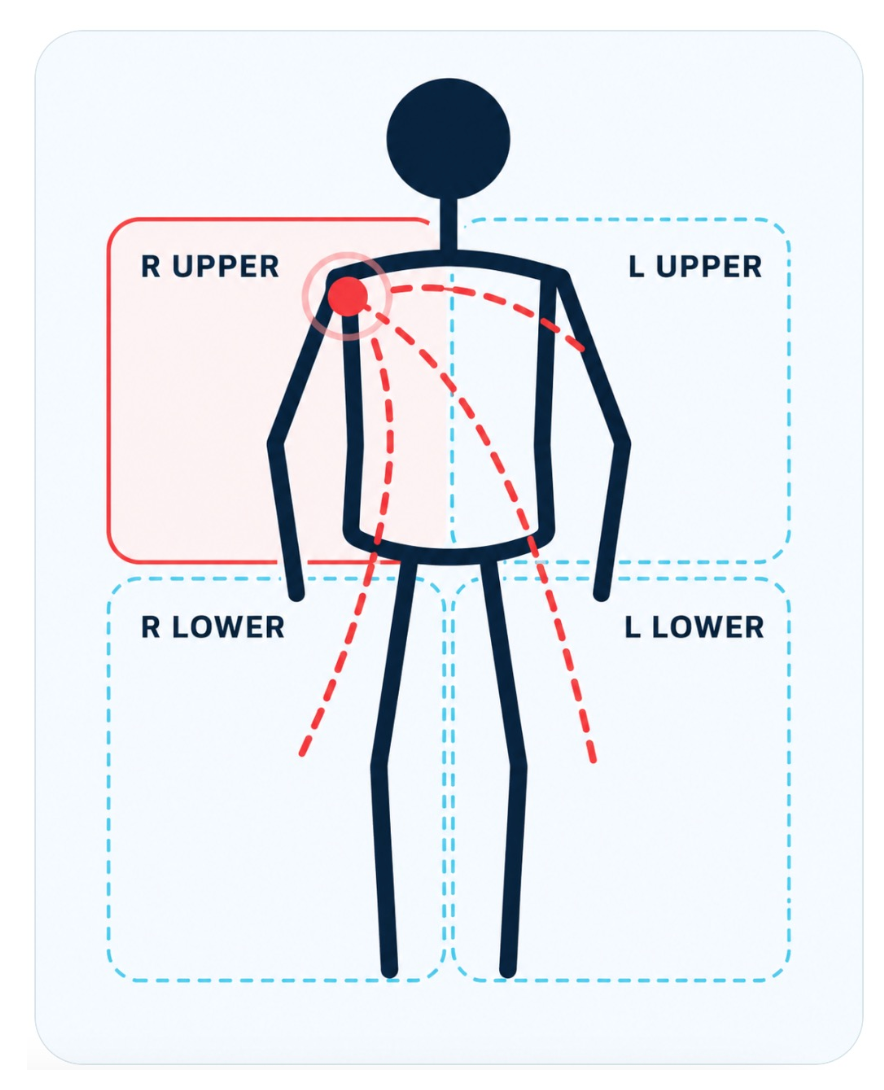
Let’s keep that patient’s original motion in mind while we look at the rest of the body.
Right upper. Left upper. Right lower. Left lower. Trunk.
The upper quadrants include the neck, shoulder, thoracic spine, ribs, arm, and hand.
The lower quadrants include the lumbar region, pelvis, leg, and foot.
When one quadrant is yucky, I compare motions in the other three and the trunk to find a yummy option to work with.
Then we go back to the original motion.
We’re looking for a useful response in the patient in front of us. That’s why the comparison and the retest stay together.
An unexpected result raises questions. I want you to be able to look at the research behind the conversation.
The research collection includes peer reviewed trials, assessment reliability research, and clinical case reports. Topics include the movement assessment scale, shoulder rotation in baseball players, and frozen shoulder.
In one study of cross education, training one arm increased strength in the untrained arm by 47%. This is supporting research on how training one side can affect the other.
A hamstring flexibility study reported a 12.15 degree gain with Total Motion Release, compared with 7.15 degrees in controls.
The research gives us findings to examine. The retest gives us feedback from the person in front of us.
Research source: Total Motion Release research collection
The full pathway includes 112 CE hours. TMRc Foundations includes 48 hours, and TMRmc Master includes 64 hours.
Athletic Training
BOC Approved Provider. Provider ID 3595.
Chiropractic
PACE Approved Provider. Total Motion Release Seminars.
Massage Therapy
NCBTMB Approved Provider. Provider ID 1241.
Occupational Therapy
AOTA Approved Provider. Provider ID 6471.
Credit depends on your profession, state, and completion format.
Trent’s comment gets right to the surprise of seeing a change somewhere other than the area being moved.
I’ll let him and the other practitioners tell you in their own words.
Phenomenal what I have seen. For example, getting neck extension better with a leg raise. I was very skeptical and doubtful... yet no longer.
I found Tom when I had sciatica and an SI dysfunction. And during a 2 hour webinar he was doing my pain decreased over 70%. Needless to say I wanted to learn more and signed up!
It's amazing I use this on everyone!
This is one of the best methods I've seen over my entire career. I am amazed at what Tom teaches.
I want you to see how the two certifications fit together.
Foundations teaches the exercise system. Master develops how you use the Total Motion Release concept with your existing techniques and more detailed clinical applications.
Learn the repeatable seven step routine for assessment, treatment, and progression. See how it’s applied across orthopedic, neurological, pediatric, acute, and chronic presentations.
Take that routine into the remaining five body positions. Learn how to adapt it for infants, toddlers, frail seniors, and people with limited mobility.
Go deeper into the exercise system with 360 degree joint assessment, focused five minute treatment, and the ACE Card for severe pain.
Your Foundations training includes lifetime course access, free retakes, and lifetime help from me by Telegram, WhatsApp, text, or call.
Bring Total Motion Release decision making into manual therapy and condition specific treatment. Work through programs for the spine, neck and jaw, shoulder and hip, and extremities.
Apply the concept across fitness, posture, initial evaluations, core work, stretching, massage, and life skills. Explore 3D combinations as part of your clinical applications.
Develop the seven step home program and explore power motions, positioning, foam rolling, instruments, injury training, and ambidextrous training.
Bring the advanced seven steps and daily note into your work. Explore vertigo, flow, trigger points, Total Motion Release gait, and teaching in an online group.
Your Master training includes the same lifetime course access, free retakes, and lifetime help from me by Telegram, WhatsApp, text, or call.
Here’s the math.
TMRc Foundations, Levels 1 to 3: $997 separately.
TMRmc Master, Levels 4 to 7: $997 separately.
You save $997.
Your purchase includes:
You can return to the material as you put it to work with your caseload. And when you have a question, you have someone to ask.
112 CE hours total. Credit depends on your profession, state, and completion format.
Ends Cyber Monday, November 30, at 11:59 PM Pacific.
The next time a yucky motion has your attention, I want you to have a process for finding a yummy motion to work with.
Compare motions, use the yummy one, and retest the yucky one.
That’s where we begin. Across all seven levels, we keep building how you use that thinking with your patients and the techniques you already practice.
Get both Total Motion Release certifications for $997 total instead of $1,994.
Save $997 and get immediate access to both. Lifetime course access, free retakes, and lifetime help from me are included.
The offer ends Monday, November 30, at 11:59 PM Pacific.
I’d love to help you put it to work.